
Zero to 10K Monthly Visitors: A Realistic Timeline for New Sites
I watched my first site flatline for four months before anything happened. Almost quit twice. Here's the timeline nobody shows you, plus what I learned about why most people bail too early.
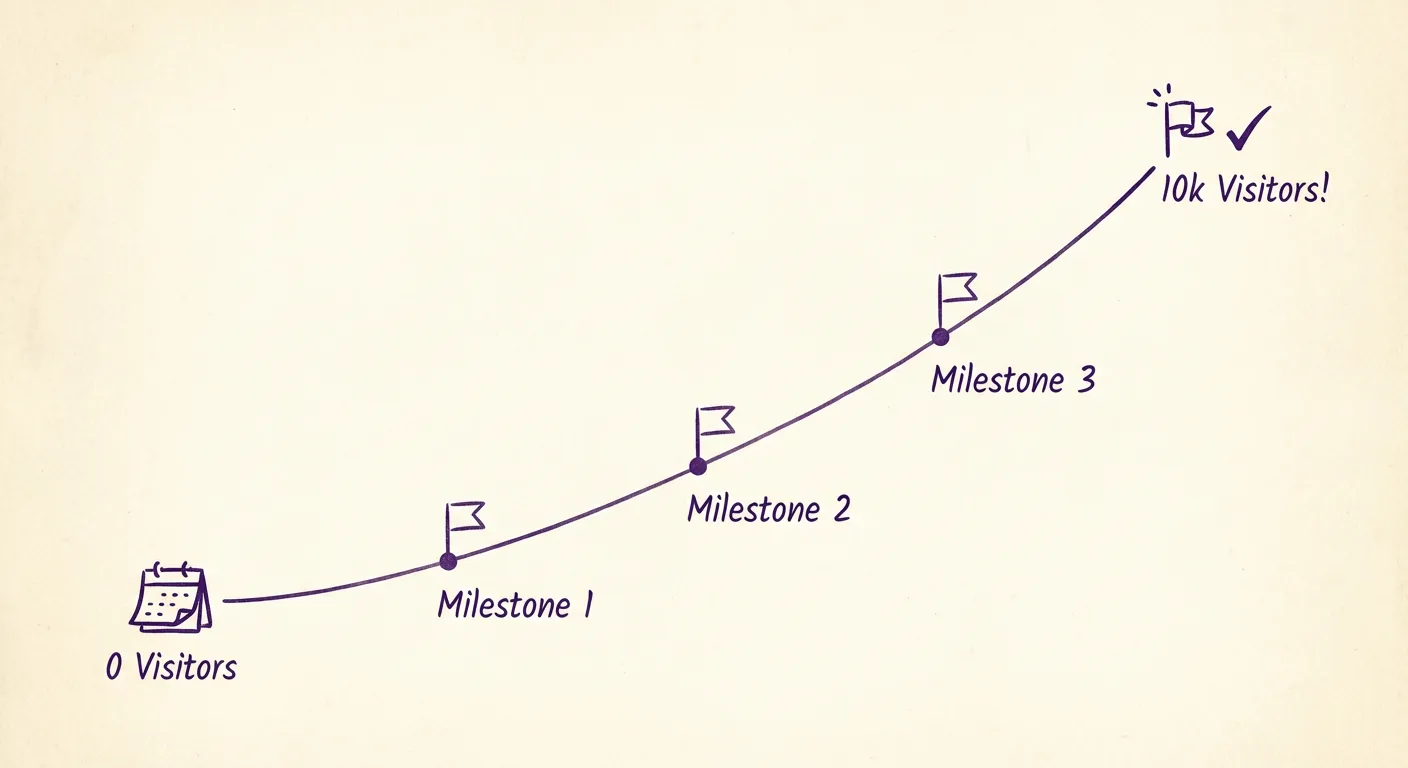
You launch a website. You write great content. You wait.
Nothing happens.
You check Google Search Console every morning. Still nothing. Maybe a few impressions. Zero clicks.
This is where most people give up. They assume SEO doesn't work or they're doing something wrong. The truth? They quit right before things get interesting.
Here's what actually happens when you start from zero, based on data from real sites that made it to 10,000 monthly visitors and beyond.
The uncomfortable truth about timelines
SEO is not a sprint. It's a marathon where the first few miles feel like you're running in sand.
Google needs time to figure you out. Are you spam? Are you legit? Will you stick around? The average page ranking #1 in Google is about 5 years old. Over 72% of top-10 pages are more than 3 years old.
That doesn't mean you need to wait 5 years. But it does mean you need patience.
For a new website targeting 10,000 monthly organic visitors, expect:
- Low-competition niche: 6 to 12 months
- Medium competition: 12 to 18 months
- High competition (finance, health, legal): 18 to 24+ months
This assumes you're doing everything right. Content velocity. Technical health. Backlinks. If you're just publishing a post every two weeks and hoping for magic, add 6-12 months to those numbers.
Month 0-1: the setup phase
Your first month is boring but necessary.
You're not ranking for anything. You won't see traffic. That's normal.
Focus on setting up Google Search Console and Analytics, fixing technical issues (crawl errors, site speed, mobile responsiveness), publishing your first cluster of content (5-10 strong articles minimum), and getting indexed by Google.
By the end of month 1, you should see your pages showing up in Google's index, a few impressions in Search Console (people seeing your site in results), and maybe 1-2 clicks from very specific long-tail queries.
That's it. Don't expect more.
Month 1-3: the quiet stretch
Months 1 through 3 are where most people panic.
You're publishing content. You're doing the work. But your traffic graph looks like a flatline.
This is the "Google Sandbox" effect. Google is watching you. Testing you. Seeing if you're consistent or just another flash-in-the-pan site that'll be dead in 6 months.
What actually happens: Your pages might rank on page 2 or 3 for long-tail keywords. Impressions slowly tick up (100, then 500, then 1,000). You might get 10-50 clicks per month total. Rankings fluctuate wildly (page 15 one day, page 8 the next).
This volatility is normal. Google's trying to figure out where you belong.
Your job: Keep publishing. Keep building links. Don't change your entire strategy because you're not seeing results yet.
By month 3, you should have 20-30 high-quality pages published, 2-5 pages ranking in the top 20 for long-tail queries, and 100-500 total monthly clicks.
Month 3-6: signs of life
This is when things get interesting.
Your content starts sticking. Some pages break into the top 10. You see your first taste of real traffic.
What to expect: Several pages ranking on page 1 for easier, long-tail terms. 500-1,500 monthly organic visitors. More stable rankings (less day-to-day volatility). Your first backlinks from guest posts, directories, or mentions.
At this stage, you can identify what's working. Which topics are gaining traction? Which keywords are you ranking for? Double down on those patterns.
One site I studied hit 1,100 visitors in month 4 by focusing entirely on low-competition keywords with clear search intent. Another took until month 6 but ended up at 2,200 visitors by publishing 8 articles per week.
The key variable? Content velocity and depth. Sites publishing 6-10 in-depth articles (1,500+ words) per week grow faster than sites publishing 2-3 medium articles.
Month 6-9: compounding kicks in
SEO compounds like interest in a savings account.
Your old articles start ranking better. Your new articles rank faster because Google trusts your domain more. Traffic doesn't grow linearly. It curves upward.
What happens: 2,000-5,000 monthly organic visitors. Multiple pages in the top 5 for target keywords. Backlinks coming in without you asking (people citing your content). Internal linking structure paying off (new pages rank faster).
This is when you should see your effort paying off. If you're NOT seeing growth by month 6, something is wrong. You're targeting keywords that are too competitive, your content isn't good enough, you have technical issues hurting you, or you're not building any backlinks.
Check your strategy. Most sites hitting 10k visitors had at least one backlink by this point. According to a Semrush study, 92.3% of domains that maintained top-100 rankings had at least one backlink.
Month 9-12: breaking through
This is the payoff period.
If you've been consistent with content and links, month 9-12 is when you hit 10,000 monthly visitors.
One case study showed a site growing from 445 to 103,000 visitors in 13 months purely through content velocity. Another hit 10,100 clicks in just 4 months by publishing heavily in a low-competition niche.
Your traffic breakdown at 10k might look like: 50-100 strong pages published, 10-20 pages driving 80% of your traffic, 5-15 referring domains pointing to your content, and several #1 and #2 rankings for medium-competition keywords.
You're no longer fighting for scraps. You're competing with established sites and winning.
What slows sites down
Some sites take 18-24 months to hit 10k. Why?
Targeting the wrong keywords. Chasing high-competition keywords as a new site is a waste of time. You won't rank for "SEO tips" or "best CRM software" in your first year. Focus on longer queries (3+ words). Lower difficulty scores. Clear search intent.
Publishing too slowly. One article per week won't cut it. You need volume to compete. Top-performing new sites publish 1,000-1,500+ word articles multiple times per week. That's how you build authority fast.
Ignoring backlinks. Content alone won't get you to 10k in a reasonable timeframe. You need referring domains. Even 5-10 quality backlinks make a massive difference. Sites that consistently acquire links grow faster and hold their rankings longer.
This is where Revised helps. Instead of spending hours manually prospecting for backlink opportunities, buying a domain that already has them skips the prospecting entirely. Listings on the marketplace carry verified referring domains from authoritative sites like Wikipedia, Reddit, and niche blogs. You buy the domain outright and point it wherever makes sense.
Technical issues. Slow site speed, broken internal links, poor mobile experience. These kill your growth before it starts. Run a technical audit. Fix the basics. Google's Core Web Vitals matter.
Quitting too early. The biggest mistake? Giving up at month 4 or 5. That's right when your compounding is about to kick in. Stick with it.
How to track progress
Don't obsess over daily traffic. Look at trends over weeks and months.
Months 0-3: Track indexation (how many pages Google has crawled), watch impressions grow in Search Console, monitor keyword positions for long-tail queries.
Months 3-6: Count pages in the top 20 and top 10, track non-branded clicks (traffic from people who don't know you yet), measure referring domains acquired.
Months 6-9: Monitor traffic per topic cluster, check share of page-1 keywords, track link velocity (new backlinks per month).
Months 9-12: Measure sustained organic sessions, track conversions from organic traffic, monitor retention of top-10 rankings.
Use Google Search Console, Google Analytics, and a tool like Ahrefs or Semrush to track everything.
How to speed things up
You can't game Google into ranking you faster. But you can optimize your approach.
Target low-competition keywords first. Go after 3-5 word queries with low keyword difficulty. Get a few wins on the board. Build momentum. Once you're ranking for 20-30 long-tail terms, start targeting medium-difficulty keywords.
Publish in clusters. Don't scatter your content across random topics. Build deep clusters around 3-5 core themes. Publish 10-15 articles on one topic. Link them together. This signals topical authority to Google.
Build links consistently. One quality backlink per week compounds fast. By month 6, you'll have 24 referring domains. That's enough to compete in most niches. Or buy a domain that already has a comparable referring-domain count verified, and skip most of that timeline outright.
Refresh old content. After 6 months, go back to articles that didn't hit the top 10. Update them. Add new sections. Improve the intro. Re-publish. Google rewards freshness. Refreshed content often jumps 5-10 positions overnight.
Technical health matters. Fix crawl errors. Speed up your site. Optimize for mobile. Clean up your internal linking. A technically sound site ranks faster. Period.
Mistakes that kill momentum
Changing strategy too early. You publish 10 articles, see no results, and pivot to a completely new content plan. Stop. Give your strategy 6 months before changing course.
Ignoring search intent. You target a keyword but don't match what people actually want. If your keyword is "how to build backlinks" and you write a 500-word listicle, you'll lose to the 3,000-word guide with examples and screenshots. Match the intent. Match the format. Match the depth.
Building spammy backlinks. Avoid paid link schemes, PBNs, and sketchy directories. One toxic backlink can hurt more than 10 good links help. Focus on quality over quantity. Revised only places links on editorial sites with real traffic and authority. No spam. No risk.
Publishing thin content. 500-word blog posts don't cut it anymore. The average top-ranking page is comprehensive. Shoot for 1,500-2,500 words. Cover the topic thoroughly.
Neglecting internal links. Your new articles won't rank if Google can't find them. Link from your homepage to your best content. Link from old articles to new ones. Build a web, not a pile.
Real examples
These are actual sites that hit 10k monthly visitors starting from zero:
Case 1: Blog in general niche. Timeline: 12 months to 10k visitors. Strategy: Keyword research, long-form content, consistent publishing. Result: Steady growth from month 6 onward.
Case 2: SaaS blog. Timeline: 4 months to 10,100 clicks. Strategy: Heavy publishing (multiple articles per day initially). Result: Explosive growth in low-competition niche.
Case 3: Content-focused site. Timeline: 13 months to 103,000 visitors. Strategy: Pure content velocity, no technical optimization, minimal backlinks. Result: Proved that great content at scale compounds fast.
Case 4: Local service site. Timeline: 13 months to 7,500 visitors. Strategy: Programmatic SEO, scalable content model. Result: Consistent growth through templated but valuable pages.
The pattern? High content velocity. Consistency. Patience.
AI and search in 2025
Google's not the only game anymore. ChatGPT, Perplexity, and other AI tools are pulling answers from the web.
The good news? The same principles apply.
AI chatbots cite authoritative sources. If you have backlinks from trusted sites, you're more likely to be referenced.
That's why building authority matters more than ever. It's not just about Google. It's about being the source everyone trusts.
A domain with the right history helps here too. Revised lists domains with backlinks from sites AI models already trust: Wikipedia, Reddit, Hacker News, academic sources. When your site inherits links from these platforms, AI tools notice.
Learn more about how AI is changing search in our post on AI and search in 2025.
Your 12-month roadmap
Here's your plan to hit 10k monthly visitors in 12 months:
Months 0-3: Build the foundation. Publish 30-40 high-quality articles (1,500+ words each). Target low-competition keywords exclusively. Fix all technical SEO issues. Acquire 3-5 backlinks from directories, partners, or guest posts.
Months 3-6: Scale content and links. Publish 20-30 more articles. Start targeting medium-difficulty keywords. Build 10-15 backlinks total. Refresh top-performing content from months 1-3.
Months 6-9: Double down on what works. Identify your top 10 performing articles. Publish 10-15 related articles in those clusters. Acquire 5-10 more backlinks. Start building internal link hubs around top topics.
Months 9-12: Push to 10k. Publish 20-30 more articles. Target higher-difficulty keywords where you have topical authority. Build 10+ more backlinks. Refresh underperforming content.
By month 12, you should have 80-100 published pages, 30-50 backlinks from quality domains, 5-10 pages ranking in the top 3 for target keywords, and 10,000+ monthly organic visitors.
Buying a domain to compress the authority timeline
Manual link building takes forever.
You prospect. You pitch. You follow up. And most outreach goes nowhere.
Revised is a different approach entirely: a marketplace of aged and expired domains, verified for real referring domains from authoritative sources. You buy one outright instead of spending months chasing placements.
It's not a substitute for the content and technical work in the rest of this timeline, but starting from a domain with genuine history instead of a brand-new one changes where your authority curve begins.
If you're serious about hitting 10k visitors in 12 months, authority is one of the levers. Browse what's available and see if there's a fit for what you're building.
The honest take
SEO timelines are longer than most people expect. But they're predictable.
If you publish consistently, target the right keywords, build links, and stay technically sound, you will hit 10k monthly visitors. It's not a matter of if. It's a matter of when.
Most people quit at month 3 or 4. Don't be most people.
Stick with it. Track your progress. Adjust based on data. And remember: SEO compounds. Your month 12 will look nothing like your month 1.
Keep going.