
Answer Engine Optimization (AEO): The Complete Guide for 2025
58% of searches end without a click now. I watched my traffic patterns shift over six months and had to completely rethink how I structure content. Here's what I learned.
58% of searches now end without a single click.
That number keeps me up at night sometimes.
Users ask a question. They get an answer. Done. That answer might come from a featured snippet, a voice assistant, an AI chatbot, Google's AI Overviews. The common thread? Someone's content powers that answer. If it's not yours, you're losing ground.
What is AEO anyway?
Answer Engine Optimization is optimizing your content to be selected as the direct answer to queries. Featured snippets, voice assistant responses, AI chatbots, knowledge panels.
The goal shifts from "rank high and get clicks" to "be the answer that gets delivered."
Think about how people search now. They don't type keyword fragments. They ask questions:
- "How do I fix a leaky tap?"
- "What's the best CRM for small businesses?"
- "How much does SEO cost?"
And increasingly, they get answers without clicking anything. The search engine or AI extracts the answer and delivers it directly.
If your content provides that answer, you win. Even if users never visit your site. You build brand authority, get mentioned as the source, become the default expert.
If you don't? Your competitors capture that mindshare instead.
AEO vs SEO vs GEO
These terms get thrown around interchangeably. They shouldn't.
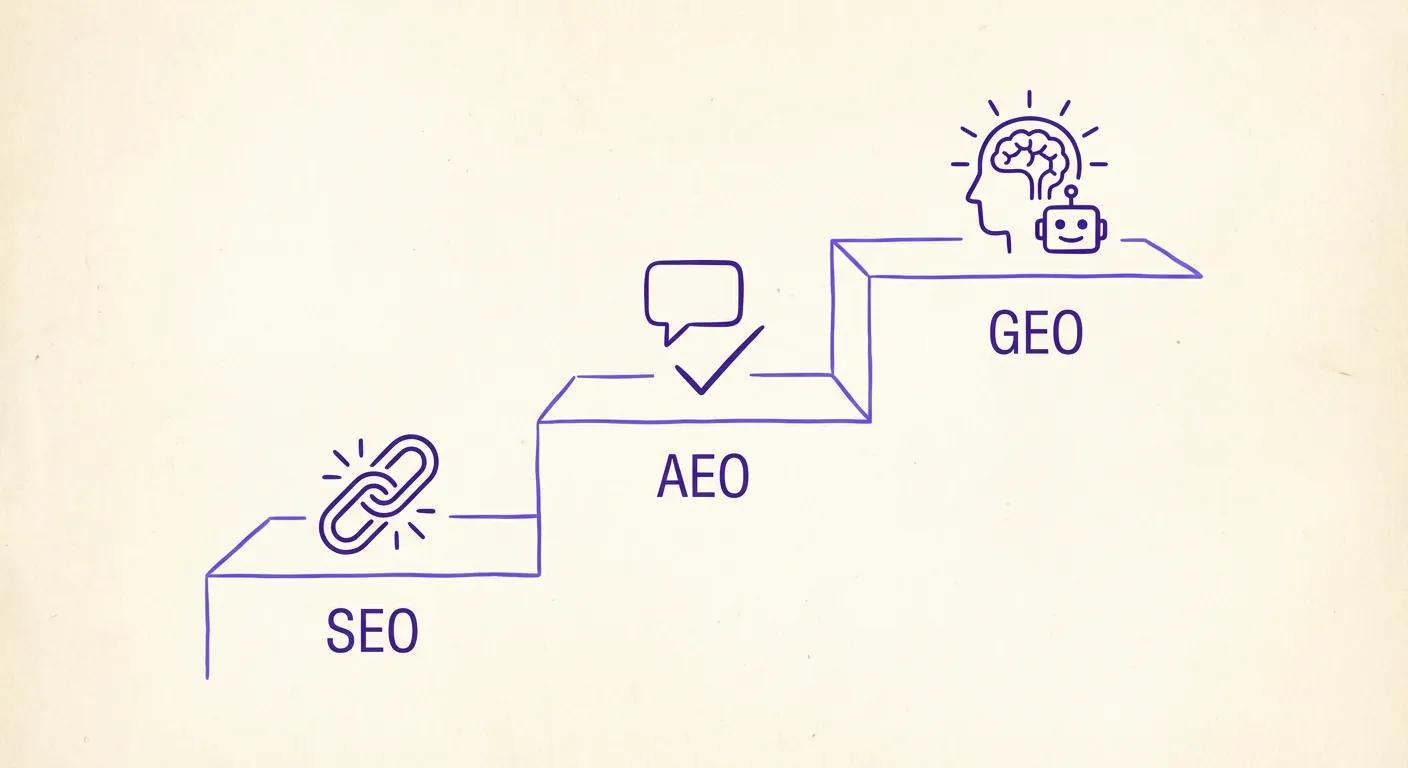
SEO is ranking in organic results. The traditional blue links. Optimize for keywords, build backlinks, improve technical factors. Goal: high rankings that drive clicks.
AEO is becoming the direct answer. Featured snippets. Voice search responses. Knowledge panels. Optimize for question-based queries and structure content so search engines can extract clear answers.
GEO is being cited by AI systems like ChatGPT, Perplexity, and Google's AI Overviews. These systems synthesize information and generate new responses. Optimize to be one of the sources they cite.
How they relate:
- SEO is the foundation. You still need organic rankings. Most AEO and GEO opportunities go to sites already ranking well.
- AEO focuses on answer extraction. Featured snippets, voice search, direct answers.
- GEO focuses on AI citation. Being mentioned and linked by generative AI systems.
All three matter. They build on each other. Master SEO first, then layer on AEO and GEO strategies.
Why AEO matters now
The numbers tell the story:
- 58% of searches are zero-click. Users get answers without visiting any website.
- Over 8 billion voice assistants in use worldwide as of 2024.
- 40.7% of voice search answers come from featured snippets.
- Featured snippets capture 35% of clicks. Nearly double the average result.
- 75% of voice search results come from pages ranking in the top 3.
Gartner predicts 25% of organic search traffic will shift to AI chatbots by 2026.
The direction is clear. More answers delivered directly. Fewer clicks to websites. The winners will be the sites that become the answers.
The answer engine world
AEO isn't just Google. Multiple platforms deliver direct answers now.
Featured snippets
These are "position zero" results above organic listings on Google. They come in a few formats:
- Paragraph snippets - A block of text answering a question
- List snippets - Bulleted or numbered lists
- Table snippets - Structured data in table format
- Video snippets - YouTube clips with relevant timestamps
Featured snippets get massive visibility. Research shows they can increase click-through rates by 31% compared to the standard #1 result.
Winning them:
Google selects featured snippets algorithmically, but patterns emerge:
Answer the question directly. Put a clear, concise answer in the first 40-60 words after your heading.
Use the right format. Questions starting with "what" or "who" often get paragraph snippets. "How to" queries get lists. Comparisons get tables.
Match the query structure. Your heading should closely match how users phrase the question.
Rank in the top 10 first. Almost all featured snippets come from pages already on page one.
The opportunity is significant. Capture a featured snippet and you essentially own two positions on page one.
Voice assistants
Siri, Alexa, Google Assistant. They all need answers to deliver.
Voice queries are conversational and question-based: "Hey Siri, what's the weather?" "Alexa, how do I remove a wine stain?"
Voice assistants typically give one answer. One. If you're not that answer, you don't exist in voice search.
AI chatbots
ChatGPT, Perplexity, Claude, Gemini. They synthesize answers from multiple sources and deliver them conversationally.
This overlaps with GEO. The distinction: AEO focuses on structured answer extraction. GEO focuses on being cited by AI systems generating novel responses.
Knowledge panels
Those info boxes on the right side of Google results for companies, people, products. They pull from trusted sources and display authoritative information directly.
The strategies that actually work
Let me get practical.
Target question-based queries
AEO starts with understanding how people ask questions.
Use tools to find questions in your niche:
- Google's "People Also Ask" boxes
- Answer the Public
- Semrush or Ahrefs question keyword reports
- Reddit and Quora for how people phrase questions naturally
Focus on "How to..." queries (procedural), "What is..." queries (definitional), "Why..." queries (explanatory), "Best..." queries (comparison).
Then create content that explicitly answers those questions.
Structure for answer extraction
Search engines need to extract answers from your content. Make it obvious.
Lead with the answer. Don't build up to it. Put a clear, concise answer in the first paragraph, then elaborate.
Use question-based headings. "What Is AEO?" works better than "Overview" for answer extraction.
Format for different snippet types:
- Paragraph answers: 40-60 words of direct, clear text
- List answers: Use proper HTML list formatting
- Table answers: Use HTML tables for comparative data
Add summary sections. "Key Takeaways," "The Bottom Line," "TL;DR." These signal extractable answers.
Implement schema markup
Schema markup tells search engines exactly what your content contains. It's essential.
FAQ Schema for question-and-answer content:
{
  "@type": "FAQPage",
  "mainEntity": [{
    "@type": "Question",
    "name": "What is Answer Engine Optimization?",
    "acceptedAnswer": {
      "@type": "Answer",
      "text": "Answer Engine Optimization (AEO) is..."
    }
  }]
}
HowTo Schema for procedural content with steps.
Article Schema for basic content attribution.
Organization Schema for knowledge panel eligibility.
Proper schema doesn't guarantee featured snippets, but it significantly improves chances.
Optimize for voice search
Voice queries have distinct characteristics:
Conversational phrasing. People speak naturally to voice assistants. "What's the best way to..." not "best way..."
Question words. Who, what, where, when, why, how. Voice queries almost always start with these.
Local intent. Many voice searches are location-based. If you serve local markets, optimize accordingly.
Mobile context. Voice searches often happen on mobile, on-the-go. Answers need to be quick and actionable.
Target long-tail questions. Voice queries are typically longer and more specific than typed searches.
Build topical authority
Answer engines prefer authoritative sources. You can't be the answer for everything, but you can dominate your niche.
Create comprehensive topic clusters. Cover all aspects of your core topics in depth. Interlink related content.
Demonstrate expertise. Named authors with credentials. Original research and data. Unique perspectives.
Earn authoritative backlinks. Links from trusted sources signal you're a reliable answer source.
This is where building quality backlinks matters. The sites getting featured as answers are the same sites with strong authority signals. Backlinks from Wikipedia, mentions on Reddit, coverage in major publications.
Keep content fresh
Answer engines favor current information.
- Display and maintain "last updated" dates
- Regularly refresh evergreen content with new data
- Cover emerging topics quickly
- Remove or update outdated information
Stale content gets passed over for fresher alternatives.
Measuring AEO success
Standard SEO metrics don't fully capture AEO performance. Add these:
Featured snippet tracking
Use Semrush, Ahrefs, or Moz to track which pages have featured snippets. Monitor gains and losses.
Voice search testing
Periodically ask voice assistants questions in your niche. Note whether you're the answer and how your response is delivered.
Impressions vs clicks
High impressions with low clicks might indicate you're powering featured snippets or AI answers. Users see you but don't need to click.
Brand awareness metrics
AEO builds brand authority even without clicks. Track brand search volume over time, direct traffic trends, brand mentions across the web.
Position zero share
What percentage of your target queries result in you owning the featured snippet? Track and improve over time.
Real results
NerdWallet's paradox: Despite a 20% decrease in site traffic, they reported 35% revenue growth. How? By ensuring their expertise reached users through featured snippets and other direct-answer formats. They became the trusted answer even when users didn't click through.
Stack Overflow's challenge: After ChatGPT launched, Stack Overflow saw an 18% drop in visits as developers got code answers directly from AI. The lesson: if you're not adapting, you're ceding ground.
The flip side: Sites that optimize for AEO often see increased brand searches, higher conversion rates from the traffic they do get, stronger positioning as authorities in their niches.
Traffic isn't the only metric anymore. Being the answer builds authority, even when users don't click.
Common mistakes
Ignoring traditional SEO. Most featured snippets go to pages already ranking in the top 10. Fix your SEO foundations first.
Thin content. Answer engines want authoritative sources. A 200-word page answering a complex question won't get selected. Depth matters.
Poor formatting. If search engines can't easily extract an answer, they'll find better-structured content. HTML matters. Semantic headings matter.
No schema markup. You're leaving visibility on the table. FAQ and HowTo schema at minimum.
Targeting wrong queries. Not every question has an answer box opportunity. Research which queries actually show featured snippets before investing.
Forgetting voice search. Mobile-first, conversational queries are growing. If content only targets keyword fragments, you're missing voice opportunities.
Neglecting authority signals. Two pages with identical structure compete on authority. The one with stronger backlinks and brand recognition wins.
The authority connection
Here's what many AEO guides miss: answer engines don't just look at content structure. They look at authority.
When Google decides which page deserves the featured snippet, it considers domain authority, backlink profile, E-E-A-T signals, brand reputation.
Two pages might have equally well-structured answers. The one with stronger authority signals wins.
This is why building backlinks matters for AEO. Not just any backlinks. Links from sources answer engines already trust. Wikipedia. Reddit. Major publications. Industry authorities.
When your site has endorsements from sources search engines and AI already rely on, you become a more credible answer provider.
Buying a domain with existing backlinks from high-trust sources gives you a shortcut on this front: browse verified listings to see what's available. Not about manipulating algorithms. About starting from genuine authority signals instead of building them from zero.
AEO + GEO: where it's all heading
AEO and GEO are converging.
Featured snippets and AI answers serve the same user need: getting information without clicking through. The tactics overlap:
- Structured, answer-first content
- Question-based organization
- Authoritative backlinks and mentions
- Schema markup and semantic clarity
- Regular content updates
Master AEO, and you're positioned for GEO. The sites winning featured snippets today are the same sites getting cited by ChatGPT and Perplexity.
Search is becoming answer-first. The sites that adapt, by becoming authoritative answer sources, will capture the visibility shifting away from traditional organic clicks.
Getting started
Here's your action plan:
Audit your featured snippet presence. Which queries do you own? Which do competitors own? Where are the opportunities?
Identify target questions. Use "People Also Ask," keyword research tools, community platforms to find questions your audience asks.
Restructure key content. Take best-performing pages and optimize for answer extraction. Lead with answers, use question headings, add FAQ sections.
Implement schema markup. FAQ and HowTo schema at minimum. Article schema for all content.
Build topical authority. Create comprehensive coverage of core topics. Earn backlinks from authoritative sources.
Test voice search. Ask voice assistants questions in your niche. See who's winning and reverse-engineer why.
Track and iterate. Monitor featured snippet ownership, voice search appearances, brand visibility. Adjust based on what works.
The zero-click era is here. The question isn't whether to optimize for it. It's whether you'll be the answer or invisible.
Ready to start from authority instead of building it? Browse verified domain listings with real backlink history from the trusted sources that power featured snippets and AI answers. See how it works.