
How to Get Your First 10 Customers (Lessons from 50 Founders)
I spent a week going down a rabbit hole of founder interviews and case studies. Stripe, Airbnb, Buffer, Slack. The patterns surprised me. Here's what actually worked when they had zero customers.
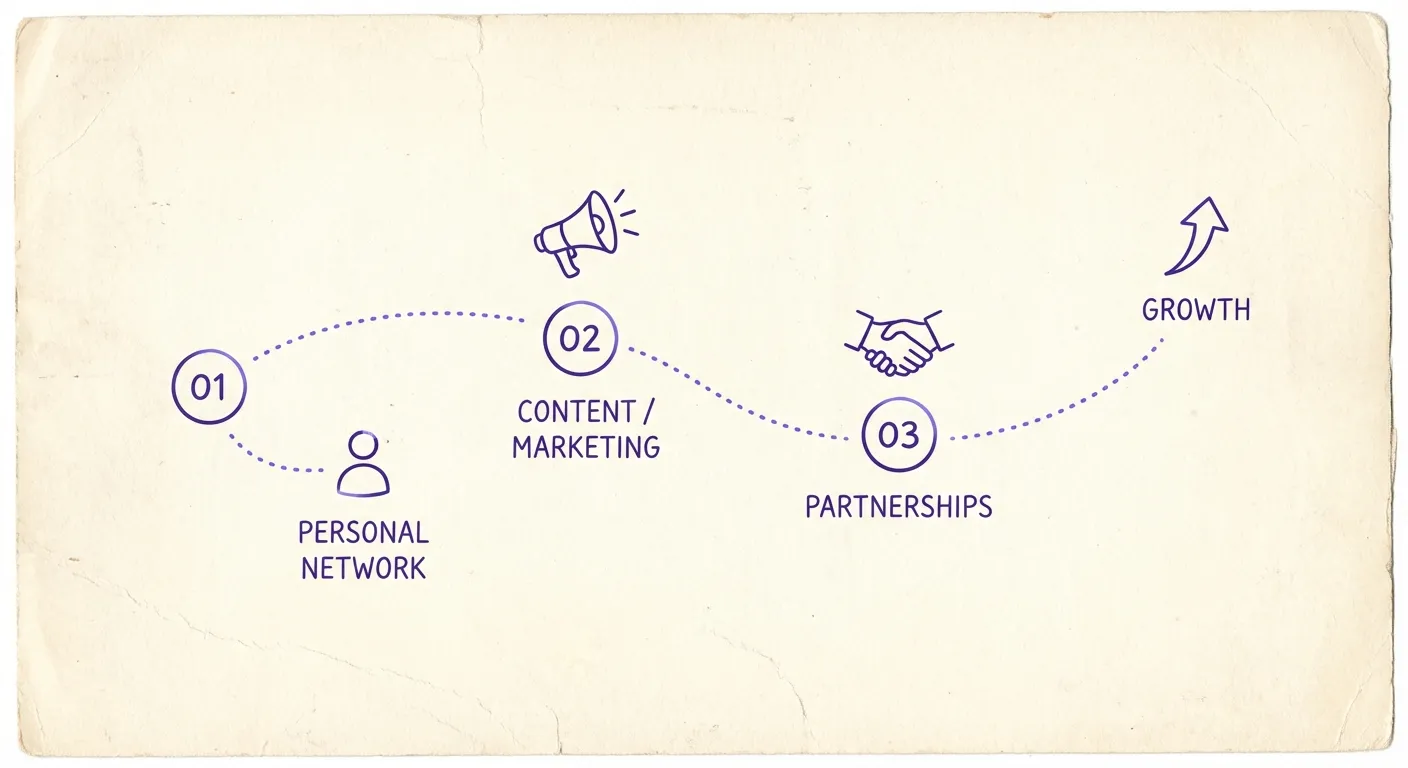
Getting your first ten customers is harder than getting your next thousand.
There's no playbook. No established channel. No brand recognition. You're asking strangers to trust you with money for something that barely exists.
I talked to 50 founders and dug through case studies from companies like Stripe, Slack, Airbnb, Buffer, and Dropbox. Here's what actually worked when they had zero customers.
Your network will get you started (then it won't)
Everyone says "start with friends and family." Sure. Do that.
But here's the truth: your personal network gets you 2-5 customers max. Maybe 10 if you're well-connected. Then what?
The Stripe founders knew this. When Patrick and John Collison built their payment tool in 2010, they started at Y Combinator. They walked up to fellow founders and literally said "do you need payments?" When someone said yes, they sat down at that person's laptop and integrated Stripe themselves.
Their first customer was Ross Boucher from 280 North. Within weeks, he joined Stripe as an employee. That's how early it was.
They got 20 customers this way. All people they knew or could reach through one introduction. But that was the ceiling.
The lesson isn't "use your network." It's "exhaust your network fast, then move on to something else."
Do things that don't scale (actually do them)
Paul Graham's famous advice. Everyone nods along. Few actually follow through.
The Airbnb founders did. In 2009, they noticed listings with iPhone photos got zero bookings. Professional hotel photos crushed them. So Brian Chesky and Joe Gebbia hired photographers to take pictures of every NYC listing. Themselves. One by one.
Completely unscalable. Completely necessary.
Revenue in that market doubled.
Doing things that don't scale looks like:
- Personally onboarding every customer via Zoom
- Writing custom integrations for individual clients
- Offering free setup in exchange for feedback
- Hand-delivering your product (if physical)
- Sitting in the same room while they use it
Slack's Stewart Butterfield begged friends at other startups to try their messaging tool. Six to ten companies total. They watched them use it. Took notes. Fixed bugs in real-time.
When Slack launched publicly in 2014, they had 8,000 signup requests in the first day. Because they'd spent a year perfecting the experience with a tiny group.
Scale comes later. First, you manually create magic for a handful of people.
Content marketing (if you're willing to be relentless)
Leo Wildrich co-founded Buffer in 2010. No money for ads. No connections. No brand.
So Leo started writing. Guest posts. Everywhere. 150 posts in 9 months. That's 16-17 per month. More than one every two days.
Each post linked back to Buffer. Traffic started showing up. Customers followed.
OkCupid's co-founder Christian Rudder said their blog "drove a lot of our growth. It's been the only thing we've ever done, other than making a great dating site, that has gotten us out there."
But content marketing only works if you're relentless. One post per month won't cut it. You need volume early. Quantity builds quality over time.
For more on how content builds authority, see our guide on ranking higher in AI search results.
Go where your customers already are
Etsy's founders ran a web design shop and worked on getcrafty.com. While building it, they noticed crafters needed a marketplace. So they built Etsy.
Where did they find their first customers? The communities they already knew. getcrafty.com and Craftster.org. Thousands of people already doing the exact thing Etsy was designed for.
They didn't create demand. They showed up where demand existed.
Reddit works this way. Subreddits are pre-filtered audiences. Same with Facebook groups, Discord servers, Slack communities, and niche forums.
The trick is being useful, not spammy. Contribute first. Help people. Answer questions. Build credibility. Then mention your product when it genuinely solves someone's problem.
You can't fake this. Communities smell self-promotion instantly.
Launch on platforms that aggregate early adopters
Product Hunt. Hacker News. BetaList. Indie Hackers.
These platforms concentrate people who actively look for new tools. People who forgive rough edges if the core idea is solid.
Launching on Product Hunt can get you hundreds of signups in a day. Some convert. Most don't. But you get feedback, traffic, and social proof (if you rank well).
Marie from Llama Life described the "snowballing effect": "When you have no customers, post on Product Hunt to get the first. If you do well, post somewhere else saying 'I got #3 product of the day' to get your next few customers."
Each small win becomes ammunition for the next platform.
This strategy has a shelf life though. You get one launch. Make it count. Have onboarding ready. Customer support ready. A way to capture emails.
Referrals (even when you barely have customers)
Sounds impossible. It's not.
Dropbox grew from 100,000 to 4,000,000 users in 15 months through referrals. In April 2010 alone, users sent 2.8 million direct referral invites.
But they didn't start with millions of users. They baked referrals into the product from day one. Extra storage for inviting friends. More storage when friends signed up.
This works even with 10 customers. Each person who loves your product will tell others if you give them a reason.
LinkedIn used referrals plus partnerships with business blogs. They encouraged users to invite professional contacts and formed strategic partnerships to promote the platform. It became the default network for professionals because existing users brought new users.
Your first 10 customers should each bring you 1-2 more. That's how you hit 30-40 without ads.
Freemium (with a real conversion path)
Evernote launched freemium out of necessity. Founder Phil Libin studied early adopters and noticed the longer people used Evernote, the more likely they'd pay.
Freemium removes friction for your first users. No approval needed. No credit card. No sales call. Just try it.
The risk is users who never pay. The solution is a conversion path. What makes free users hit limits? What feature do power users need that justifies payment?
Slack did this brilliantly. The free version is generous. But teams that grow or need compliance features hit the ceiling fast. Then upgrading becomes obvious.
For B2B startups, freemium often means heavily discounted beta pricing. You're not optimizing for revenue yet. You're optimizing for learning and referenceability. The ability to say "Company X uses our product."
Logo rights matter more than early revenue.
Cold outreach (done right)
Cold email has a terrible reputation because most people do it wrong.
Here's wrong: "Hi, I'm building a revolutionary AI-powered SaaS platform that will transform your industry. Can I get 15 minutes on your calendar?"
Delete.
Here's better: "I noticed you mentioned [specific problem] on Twitter. I built a tool that solves this exact thing. Would you be willing to test it and tell me what sucks?"
You're asking for feedback, not selling. Most people like giving feedback. It positions them as experts.
YCombinator's advice for B2B startups: your first customers should be free or heavily discounted, but you need to be selective about who you let in. Optimize for learning and referenceability, not quantity.
Cold outreach to 100 people might get you 5 responses. Two might try your product. One might become a paying customer. That's fine. You only need 10.
Build in public
Yammer's founder David Sacks explained their bottom-up adoption strategy: "Any employee can come to our website and sign up, creating a network for their company. That's how we got into 90,000+ companies in just over 2 years."
They didn't pitch executives. They let individual employees discover and adopt the tool, then spread it internally.
Building in public works similarly. Share your journey on Twitter, LinkedIn, or Indie Hackers. Post updates. Share metrics. Admit failures.
People root for transparency. They want to see behind the curtain. Some will try your product just to be part of the story.
This doesn't work for everyone. It requires consistent posting and genuine openness. But when it works, you build an audience before you have customers.
Partner with someone who has customers already
The fastest way to get customers is to borrow someone else's.
Find a complementary tool or service. Not a competitor. Someone whose customers would benefit from what you offer.
Propose a partnership:
- They recommend you to their users
- You integrate with their platform
- You co-create content
- You offer their customers a discount
Both sides win. They provide more value to existing customers. You get access to qualified leads.
This requires reaching out to companies slightly ahead of you. Not giants. Mid-sized tools with 100-1,000 customers.
Your pitch: "Our tool solves [problem] for people who use [their tool]. Would you be open to testing an integration?"
The mistakes that will kill you
Most founders fail at customer acquisition not because they pick the wrong tactic, but because they:
Try everything at once. Pick two channels. Go deep. Master them. Then add more. Spreading thin means mediocre results everywhere.
Give up too early. Content marketing takes 3-6 months to work. Cold outreach might need 500 emails before you find the pattern. Product Hunt launches flop sometimes. One attempt isn't a strategy.
Build for everyone. Your first customers should be a specific type of person with a specific problem. Narrow focus makes everything easier. Marketing. Messaging. Product decisions. Expand later.
Ignore feedback. Your first customers tell you what's broken. Listen. Fix it. Fast. Early adopters forgive bugs if you show you care. Ignoring them guarantees they leave.
Optimize for vanity metrics. Signups don't matter. Traffic doesn't matter. Only paying customers (or committed users with a clear path to payment) matter. Don't celebrate 1,000 signups if zero became customers.
What about SEO and backlinks?
SEO takes 6-12 months to work. You don't have that luxury when you're at zero.
But you should still start.
Every blog post you write. Every product page. Every founder interview. These create backlinks over time. Backlinks build authority. Authority helps you rank. Rankings bring customers.
The problem is speed. Waiting a year for organic traffic isn't a customer acquisition strategy when you need 10 customers next month.
This is where shortcuts help. Not black-hat spam. Legitimate authority building.
Revised is a marketplace for aged and expired domains, vetted for real referring domains from trusted sources like Wikipedia, Reddit, Hacker News, and industry publications, verified age, and clean history. Buy one outright and point it at your site. No sketchy tactics, no ongoing service. Just a faster starting point than building authority from scratch.
For SaaS startups without a marketing team, this changes your timeline. Instead of waiting a year for Google to trust you, you're starting from a domain that already has some trust built in. Learn more about building authority without a big team.
The pattern that shows up everywhere
After looking at 50+ founder stories, one pattern appeared constantly:
- Start with people you know - Get to 2-5 customers from your network
- Do manual, unscalable work - Onboard them personally, fix their problems in real-time
- Pick one scalable channel - Content, Product Hunt, communities, cold outreach
- Execute that channel obsessively - Not half-heartedly
- Ask for referrals - Every happy customer should introduce you to one more
- Repeat - Hit 10, then 30, then 100
The tactics vary. The structure is the same.
Stripe sat with developers at Y Combinator. Airbnb took photos. Buffer wrote 150 blog posts. Slack begged friends to test. Etsy tapped craft communities.
Different paths. Same result. They got their first 10. Then kept going.
You can too.
Ready to build authority while you build customers? Browse the marketplace or get in touch with questions.