
What is E-E-A-T and Why Google Cares About It
I kept seeing E-E-A-T mentioned everywhere but nobody explained it without making it sound like rocket science. Turns out it's simpler than the acronym suggests. Here's what it actually means for your rankings.
Google processes billions of queries every day. Some of those queries could genuinely hurt people if they get bad answers. Medical advice. Financial guidance. Legal questions.
So how does Google decide which pages deserve to rank for these high-stakes topics?
Enter E-E-A-T.
The acronym, explained
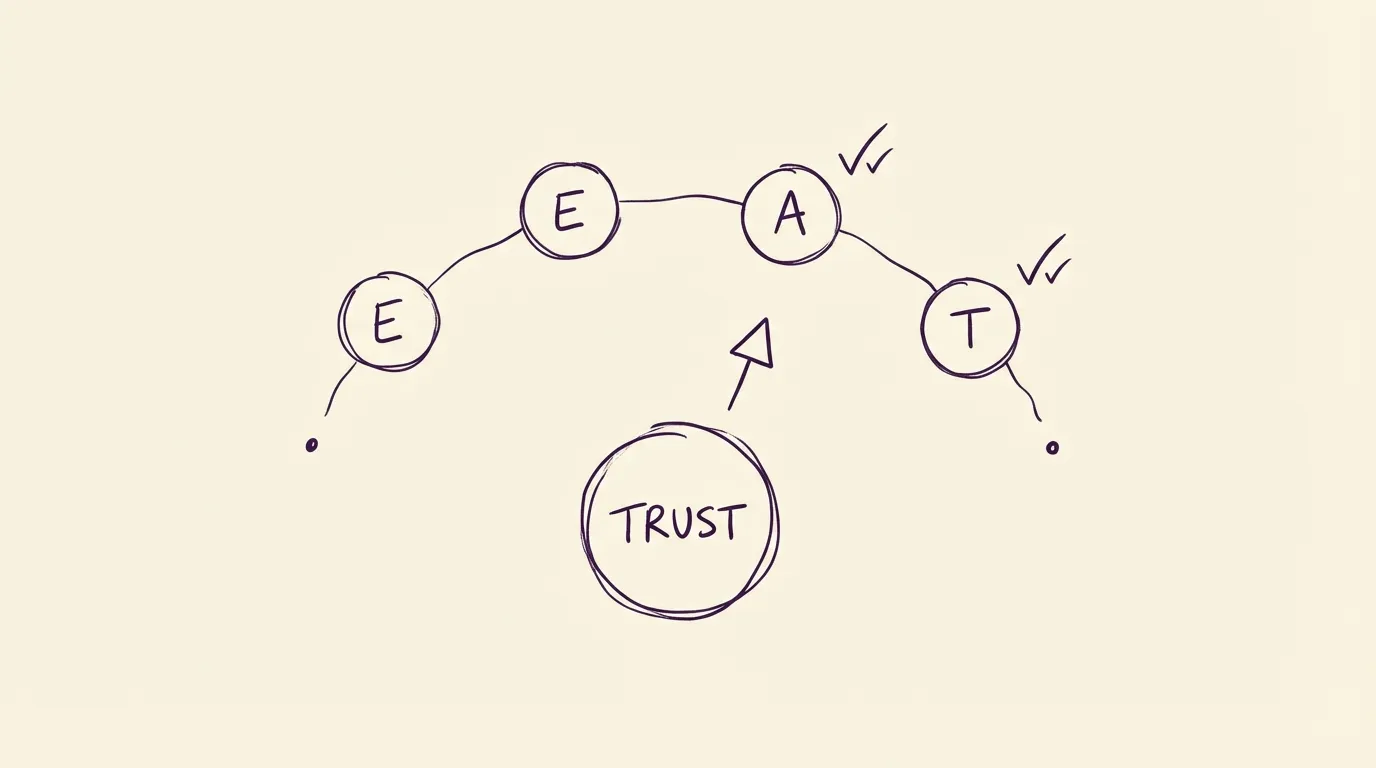
E-E-A-T stands for Experience, Expertise, Authoritativeness, and Trustworthiness. It's a framework from Google's Search Quality Rater Guidelines, a 170+ page manual that human reviewers use to evaluate search results.
The framework evolved from the older E-A-T model when Google added "Experience" in December 2022. They realized first-hand knowledge matters. Someone who's actually used a product or visited a location brings something that desk research can't replicate.
Here's what trips people up: E-E-A-T isn't a direct ranking factor. There's no "E-E-A-T score" that Google assigns to your site. Instead, it's a conceptual framework. Google's algorithms look for signals that correlate with these qualities. The raters use E-E-A-T to evaluate whether Google's algorithms are actually surfacing trustworthy content.
Trust sits at the center. The other three feed into it.
Breaking it down
Experience: have you actually done this?
Experience is about first-hand knowledge. Did you actually use the product? Visit the place? Go through the process you're writing about?
Google's guidelines explicitly look for content that shows real-world involvement. For product reviews, this means original photos and videos of you using the product, specific measurements and test results, details about your testing methodology, personal insights that only come from actual use.
A review that summarizes Amazon specs isn't demonstrating experience. A review with your own photos showing the product in your kitchen, with notes about how it performed over three months of daily use? That's experience.
This matters if you're building content strategies. If you're writing about your industry, share what you've learned from actually doing the work. Case studies from your own clients. Lessons from projects that failed. Specific numbers from experiments you've run.
AI can't fake this. And that's increasingly the point.
Expertise: do you know what you're talking about?
Expertise relates to skill and knowledge. For technical topics like medicine, law, and finance, this often means formal qualifications. A medical article reviewed by a doctor carries more weight than one written by someone with no medical background.
But expertise isn't always about credentials. For a guide on fixing motorcycles, 20 years of workshop experience beats a relevant degree.
To demonstrate expertise: include detailed author bios with relevant background, cite authoritative sources (primary research, government data, academic papers), get content reviewed by qualified experts for YMYL topics, and maintain factual accuracy. Errors destroy expertise signals fast.
For startups, this often means using your team's background. If your CTO has 15 years in infrastructure, have them author or review technical content. If your CEO built and sold two companies in the space, that experience is a genuine expertise signal.
Authoritativeness: does your industry recognize you?
Here's where it gets interesting for SEO.
Authoritativeness is largely about reputation. Not what you say about yourself. What others say about you. It's established through external signals: being cited by other experts in your field, earning links from respected publications and websites, getting mentioned in industry discussions, being referenced as a source by journalists and researchers.
This is the "who links to you" question. And it's where building quality backlinks becomes critical.
Think about it from Google's perspective. If Wikipedia cites your research, that's a strong authority signal. If Reddit discussions keep pointing people to your guides, that tells Google something. If Forbes or TechCrunch covers your company, you're building authority signals Google can measure.
This is exactly what Revised helps with. We verify domains carrying contextual backlinks from authoritative sources (Wikipedia references, Reddit mentions, trusted publications) that signal to Google (and to AI search engines) that a site deserves to be cited. You buy the domain and inherit those signals.
Authoritativeness isn't something you can claim. It's something you earn through recognition from sources Google already trusts.
Trust: where everything converges
Trust is the most critical component. Google's guidelines describe it as the culmination of the other three.
A trustworthy page is accurate in its claims, honest about limitations and potential conflicts, safe (secure HTTPS connection, no deceptive practices), and transparent about who's responsible for the content.
For e-commerce sites, trust means secure checkout and clear return policies. For content sites, it means visible authorship, disclosed affiliations, and correction policies. For any site, it means not trying to deceive users about who you are or what you're selling.
Trust is also contextual. A low E-E-A-T page about gardening tips probably won't harm anyone. But a low E-E-A-T page about medication dosages could genuinely hurt people. Google applies higher trust standards to higher-stakes topics.
Why YMYL topics get extra scrutiny
YMYL stands for "Your Money or Your Life." These are topics that could significantly impact a person's health, finances, safety, or wellbeing: medical advice, financial planning, legal guidance, news about civic events, safety information.
For YMYL content, Google applies "very high" quality standards. The margin for error is smaller. Demonstrating formal expertise, citing authoritative sources, and establishing clear trust signals is essential.
If you're creating content in YMYL spaces, you need visible credentials. Named authors with verifiable backgrounds. Expert review processes. Clear sourcing for any claims.
How Google actually evaluates this
Google doesn't have a team manually reviewing every page. The Quality Rater Guidelines train human evaluators who provide feedback on whether Google's algorithms are working correctly. Their ratings don't directly affect individual page rankings. Instead, the data helps Google validate and improve its automated systems.
So what signals do those automated systems look for? Based on Google's guidance and industry research:
For Experience: Original images and media, detailed and specific observations, first-person perspective with unique insights.
For Expertise: Author information and credentials, accurate and well-sourced information, appropriate depth for the topic.
For Authoritativeness: Backlinks from reputable sources, mentions and citations from experts, recognition from industry publications.
For Trust: HTTPS security, clear contact information and "About" pages, transparency about ownership and funding, accurate and honest content.
The March 2024 core update reinforced these priorities. Google reported a 45% reduction in "low-quality, unoriginal content" in search results after the rollout. The message is clear: they're getting better at identifying and demoting content that lacks genuine E-E-A-T signals.
What you can actually do
Enough theory. Here's the practical stuff.
Build transparent authorship
Every piece of content should have a visible author. Create detailed author pages that show professional background and credentials, other published work, social profiles and verification, and why this person is qualified on this topic.
For YMYL content, include credentials prominently. "Reviewed by Dr. Sarah Chen, MD" is a trust signal Google can identify.
Show your work
Document your experience. If you're reviewing products, photograph your testing process. If you're sharing strategy advice, show results from clients (with permission) or your own projects.
Original data is powerful. Run surveys. Conduct experiments. Publish findings. This creates unique value that's difficult to replicate and easy to verify.
Earn authority signals
This is the hard part. You can't declare yourself authoritative. You have to earn it.
Strategies that work: create content worth citing (original research, comprehensive guides, unique data), build relationships with journalists and industry publications, participate in relevant communities (Reddit, Quora, industry forums), speak at conferences and contribute to industry discussions, acquire backlinks from authoritative domains.
Authority compounds. Each legitimate mention makes the next one easier to earn. Starting is the hard part.
Maintain technical trust
Some trust signals are purely technical. Use HTTPS across your entire site. Provide clear contact information. Create an accessible "About" page explaining who you are. Have a privacy policy and terms of service. Ensure your site is fast and mobile-friendly.
These might seem basic, but they're table stakes. Missing them raises flags.
Fix your "who, how, and why"
Google recommends a simple framework for evaluating your content:
Who created it? Is the author clearly identified? Can users learn about their background?
How was it created? Is the process transparent? If AI assisted, is that disclosed?
Why was it created? Is the primary purpose to help users, or to game search rankings?
Content created to genuinely help people, by identifiable experts, using transparent methods. That's what E-E-A-T is trying to surface.
E-E-A-T and AI content
Let's address the elephant. AI-generated content is everywhere. Does it violate E-E-A-T?
Google's position: AI content isn't automatically bad. What matters is quality and purpose.
But here's the catch. AI can't demonstrate genuine experience. It can't have used your product or visited your location. This makes experience a critical differentiator in an era of abundant AI-generated text.
Google's March 2024 update specifically targeted "scaled content abuse," mass-producing low-quality content regardless of whether humans or AI created it. The method doesn't matter. The helpfulness does.
If you use AI to help create content, ensure human expertise informs and reviews the output, first-hand experience is woven throughout, the content adds genuine value beyond what AI could produce alone, and you're transparent about your process.
The connection to AI search
Here's why E-E-A-T matters beyond traditional Google rankings.
AI search engines, ChatGPT, Perplexity, Google's AI Overviews, rely heavily on the same trust signals. When these systems decide what to cite in their responses, they favor sources that demonstrate strong E-E-A-T.
Research shows that over 99% of sources cited in Google's AI Overviews come from top-10 organic results. Wikipedia and Reddit dominate ChatGPT citations. The pattern is consistent: AI trusts what Google trusts.
Building E-E-A-T today positions you for both traditional search and AI search. The content that gets cited by ChatGPT is content that demonstrates genuine expertise and authority.
For a deeper look at optimizing for AI search, see our GEO guide.
Common mistakes
Fake expertise signals. Inventing credentials or claiming expertise you don't have. Google's systems are getting better at cross-referencing claims. And if users discover you're faking, trust evaporates.
Ignoring authorship. Anonymous content on YMYL topics is a red flag. Even for non-YMYL content, clear authorship builds trust.
Neglecting off-site reputation. You can optimize on-page signals all day, but if no one else mentions or links to you, authority signals remain weak. Build external recognition.
Over-optimizing for search engines. Ironic in an SEO context, but content created primarily to rank, stuffed with keywords and thin on value, demonstrates low E-E-A-T. Google's helpful content system explicitly targets this.
Stale content. Old, outdated content suggests you're not actively maintaining quality. Update high-value pages regularly. Display "last updated" dates.
Measuring and auditing E-E-A-T
There's no E-E-A-T score to check. But you can evaluate indirectly:
After core updates: If you experience a significant traffic drop following a Google core update, E-E-A-T is often involved. Use Search Console to identify which pages and queries were most affected. Review those pages against Google's self-assessment questions.
Backlink profile analysis: Are you earning links from reputable sites? Or is your link profile dominated by low-quality sources? Authoritative backlinks correlate with authority signals.
Author and brand audits: Google your authors' names and your brand. What comes up? Is your off-site reputation building or stagnant?
Comparative analysis: Look at who ranks above you for target keywords. What E-E-A-T signals do they demonstrate that you don't?
This takes time
There's no shortcut here. E-E-A-T isn't a checkbox optimization. It's about genuinely becoming an authoritative, trustworthy source in your space.
That means creating content based on real expertise and experience, earning recognition from others in your industry, maintaining accuracy and transparency, and building the backlink profile that signals authority to Google.
Some of this is within your control. Content quality, authorship transparency, technical trust signals. You can improve these today.
Other aspects require external validation. Links from authoritative sources. Mentions by industry experts. Citations by journalists. This is where services like Revised come in, helping you build the authority signals that demonstrate E-E-A-T at scale.
Google's systems will keep evolving. AI search is adding new complexity. But the core principle remains stable: demonstrate that you genuinely deserve to rank, and you'll outperform sites that are just trying to game the system.
E-E-A-T isn't about tricks. It's about becoming the source Google and AI engines trust.